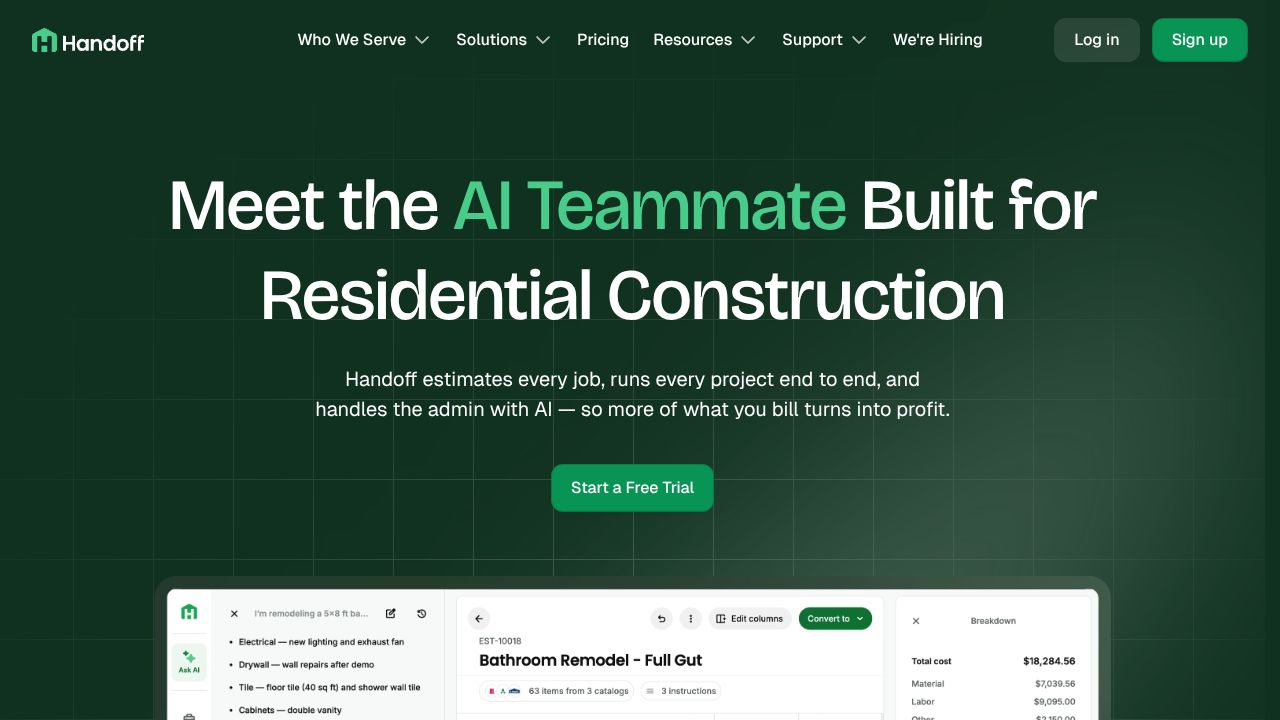
Handoff.AI vs Origami Agents: The Honest Comparison
-- Nailing Scope With A Microphone: Inside Handoff.AI’s Estimating Brain --
You know the drill—mud on your boots, client breathing down your neck, and you’re juggling a voice memo, a half-baked spreadsheet, and three browser tabs for lumber prices that changed—again. Estimates slip, proposals lag, and revenue leaks out of the bucket you just patched. Handoff.AI tackles that chaos head-on: an AI-driven, construction-specific stack that goes from raw input (text, PDFs, or voice notes) to scoped estimates, proposals, CRM records, invoicing, and even financing—without duct-taping five apps together.
Under the hood, think of a cloud-native pipeline built around three pillars: multimodal ingestion (OCR/ASR), an estimation engine that maps entities to assemblies and local supplier prices, and an operational layer (CRM + invoicing + project tracking). The design philosophy is unapologetically vertical: opinionated defaults that get residential contractors from Zero to Launch faster than generalist tools.
-- Architecture & Design Principles --
Handoff.AI’s architecture looks like an event-driven workflow stitched around a canonical “Project” object. Inputs hit specialized adapters: PDFs pass through OCR and layout parsing; text uses a structured prompt schema; voice notes get ASR transcription. A domain-tuned NLP layer performs entity extraction (rooms, tasks, materials, dimensions), then maps them to cost assemblies and line items via a ruleset enriched by LLMs. A pricing resolver queries local suppliers (e.g., Home Depot) in real time to fill unit costs. Margin configurations and tax tables are applied before handing off to proposal generation.
This separation of concerns—ingestion, interpretation, pricing, and ops—scales cleanly. Stateless microservices (or function-style workers) keep inference and parsing concurrent, while cached supplier catalogs reduce latency. The CRM, invoicing, and project modules ride on the same project record to avoid “double entry,” which is where most contracting CRMs bleed time and accuracy.
-- Feature Breakdown --
> Core Capabilities
- *
Instant AI estimates from text, PDFs, or voice notes
- *Technical: OCR for PDFs; ASR for voice; NER/LLM parsing to extract tasks, quantities, and materials; assembly matching to compute labor + material line items with local pricing.
- *Use case: You dictate a one-minute walkthrough—“10x12 bedroom repaint, minor drywall patch, baseboard replace”—and Handoff.AI returns a scoped estimate with itemized materials and labor, already margin-adjusted.
- *
AI site walkthrough transcription
- *Technical: Noise-tolerant transcription feeds an entity extractor tuned for construction vernacular (brand names, SKU-like references, units). The model normalizes measurements and maps them to a standardized scope of work.
- *Use case: On-site memo becomes a structured SOW plus a draft proposal. For First Customer Stories, this literally compresses your time-to-bid from hours to minutes.
- *
Real-time local pricing from suppliers
- *Technical: Live lookups (or frequently refreshed caches) against supplier endpoints return regional SKU-level pricing and availability. A pricing override layer supports contractor-specific costs and markup rules.
- *Use case: Lumber spikes mid-week? Refresh the estimate, regenerate the PDF, and keep your margin. That’s a real Revenue Tactics edge.
You also get a built-in CRM (leads → opportunities → jobs), digital invoicing, and customer financing hooks—key Milestone Guides across the lead-to-cash journey. Pricing starts at $149/month, with a 7-day free trial.
> Integration Ecosystem
Handoff.AI’s differentiator is supplier-side connectivity—pulling real-time material prices into estimates. Expect REST-style connectors for suppliers (authentication + rate-limited queries) and a pricing cache to avoid thrashing those APIs. Financing integrations typically rely on OAuth flows and event callbacks when approvals land. For ops, webhooks should broadcast project lifecycle events (lead created, estimate approved, invoice paid), enabling lightweight tie-ins to email, scheduling, or analytics stacks. File intake endpoints allow PDF plans or attachments to be pushed programmatically.
> Security & Compliance
Data spans PII, project photos/notes, and financial documents. Best practice here is TLS in transit, encrypted storage at rest, RBAC scoped by crew/office, and audit logs on estimate edits and price overrides. Invoicing typically routes through PCI-compliant processors rather than storing card data directly. There’s no public disclosure of formal certifications in the source; if you’re enterprise-adjacent, ask for a security whitepaper and data retention policy before rollout.
-- Performance Considerations --
The big levers are inference latency and supplier lookups. Handoff.AI mitigates by caching SKUs regionally and parallelizing OCR/ASR and entity extraction. For voice, background processing with notifications lets you capture on-site and get structured outputs without babysitting a spinner over spotty LTE. Estimates should diff efficiently—recalculating only changed assemblies—to keep reruns snappy during negotiation. Reliability hinges on graceful fallbacks when supplier APIs hiccup; saved price snapshots keep proposals stable.
-- How It Compares Technically --
While Origami Agents excels at flexible agentic logic for sales automation (think loops, branching, multi-step orchestration), Handoff.AI is better suited for contractors who need domain-tuned extraction and cost assemblies tied to local pricing—not general-purpose agents.
Sked Social automates social scheduling and AI optimization across Meta/TikTok. Different lane: content ops vs. construction ops. If your priority is lead gen on Instagram, use Sked; if it’s turning those leads into scoped jobs and invoices, Handoff wins.
Creatio brings low-code BPM/CRM with AI across industries. It’s stronger for cross-department workflows and custom data models. Handoff.AI trades breadth for opinionated depth: out-of-the-box estimating, supplier pricing, and proposals. Creatio can approximate this with a heavier build; Handoff gets contractors live faster at $149/month.
-- Developer Experience --
Handoff.AI feels product-first rather than platform-first. Contractors won’t miss SDKs; they’ll appreciate a sane UI that collapses estimate → proposal → invoice into a single flow. If you need deep programmatic control, Creatio and Origami Agents are more flexible. For marketing teams, the CRM and event webhooks are enough to wire automations into your nurture stack. Documentation depth and API surface aren’t publicly detailed—assume guided onboarding over DIY scaffolding.
-- Technical Verdict --
Handoff.AI nails the unsexy hard problem: turning messy human inputs into priced, presentable scopes—fast. Strengths: multimodal ingestion, domain-specific parsing, live supplier pricing, and a cohesive lead-to-cash loop that shrinks time-to-revenue. Limitations: fewer open-ended integrations than generalist platforms, and you’re betting on their pricing connectors staying fresh in your region. Ideal for small-to-mid residential contractors who want Zero to Launch speed, clean First Customer Stories, and pragmatic Revenue Tactics like financing baked into proposals. My hot take? As someone who color-codes estimates like my sock drawer, I’ll pick vertical AI that prints invoices over horizontal AI that prints demos—every time.
EXTERNAL TRANSACTION:
VISIT HANDOFF.AI -->